Here are some interpretations of some popular songs, that might contain coded information about design and different functions and usages of the Great Pyramid. According to this interpretation and looking at this drawing below, that show what it could be a water pool at the base of pyramid, we can imagine the pyramid is also a powered device, driven by the difference of temperatures between night and day in the desert, also amplifying this power many times through use of reverse entropy, possibly in constant communication with a computational source that regulates it that may be on the other planet. Given its height and insulating capabilities it could be in connection with maintaining the ionosphere and/or stabilizing orbit etc. and we could assume it cannot be stopped. However, the main piece that used to connect it with the ionosphere, or antenna, figured by what we knew it was the gold cap on top is missing or had been removed so it's already stopped. Its only interest nowadays is for studying it, something that others have already done, maybe the hard way in ancient times, before being damaged and maybe for reverse engineering more recently.
Could it had been build by the aliens after (hard) landing in order to maintain contact with their home-world after gradually loosing the technology brought with them through lack of infrastructure, and stabilize climate on Earth (including ionosphere and orbit) with help of their home-world, and also defend themselves from locals, themselves retreating in some subterranean caves like beneath Himalaya mountains and either waiting to be rescued or transform the whole planet including population.
One thing that might be included in this song right from the beginning or maybe the title is using the difference of temperature between day and night in the desert to create energy. I can find anyways but i would assume at that size the pyramids would contract and dilate daily by feet. The enormous pressure given by the daily contraction-dilation cycle of all limestone blocks on the granite slabs on top of the king's and queen's chamber could create some voltage through reverse piezo-electric effect, that would be the voices heard down the corridor. But also there will be friction between the limestone two tones each "bricks" or whatever they are called. There are strange effects happening at separating surfaces between solids and gases, never studied what happened at those between solids.
These vibrations could be transmitted somewhere through modulating of the entangled photons received from Polaris or again charge the cap like a capacitor, with millions of volts.
https://www.youtube.com/watch?v=49SRGhL3i3Y
Tuesday, August 29, 2017
Tuesday, August 8, 2017
About Liquid-Gas Phase Equilibrium
The molecules of liquids and gasses both attract and repel each other because of spatially distributed electrical charges of their molecules. They are also in a continuous so called Brownian motion where all molecules hit others exchanging speed and energy, the faster ones loosing energy to the slower.
Both within liquids and gases speed distribution a normal or Gaussian because they hit each others every time at a different angles and positions respect to the position of the electric charges presented at collision time which means in both phases more molecules move close to average speeds and fewer close to smaller and higher speeds.
However there are big differences in speed between the two phases, liquid and gaseous. In a closed container that holds liquid at bottom and gas on top fewer molecules in gaseous phase move much faster in order to create the same pressure and temperature as those much more numerous in the liquid phase below.
They do it because only at higher speeds they can brake the electrical bonds between them.
We also have to consider the simple fact that a molecule with a spatially distributed electric charge and weight would have a rotation energy.
In liquid phase molecules rotate less mostly oscillating because they have to stay bonded with each other. For this reason their distribution of speeds or entropy is smaller than for gases. The model is also complicated because they all move within a gravitation field which acts to completely separate the liquid and gaseous phase.
However there are big differences in speed between the two phases, liquid and gaseous. In a closed container that holds liquid at bottom and gas on top fewer molecules in gaseous phase move much faster in order to create the same pressure and temperature as those much more numerous in the liquid phase below.
They do it because only at higher speeds they can brake the electrical bonds between them.
We also have to consider the simple fact that a molecule with a spatially distributed electric charge and weight would have a rotation energy.
In liquid phase molecules rotate less mostly oscillating because they have to stay bonded with each other. For this reason their distribution of speeds or entropy is smaller than for gases. The model is also complicated because they all move within a gravitation field which acts to completely separate the liquid and gaseous phase.
Some of the total energy of molecules moving withing a gas or liquid or the so called thermal agitation is stored in the rotation momentum, not only straight linear or curve line motion momentum (because of reciprocal attraction or repelling of the electric charges their trajectories between two hits might not be a straight line but parables or more complicated ones).
So after all, the so called difference in entropy between gases and liquids could be nothing more than difference of rotation speed component of molecules within the two phases.
Turning a gas into a liquid involves bonding of the molecules and stopping of their rotation movement or reducing it to wave oscillation within a matrix.
Also. When compressing the gas molecules with a linear reciprocating motion compressor on average we do not add rotation but only linear motion and when cooling them after compression like in an AC we extract mostly rotation because the solid molecules on the side of the pipe vibrate mostly around a rotating point but do not move freely.
https://www.google.com/search?q=liquid+dipole+dipole+interaction
https://www.jstor.org/stable/984598?seq=1#page_scan_tab_contents
But what happens to the thermal agitation within the liquid if all molecules are attached to others in more than one point? Will they vibrate as a piece of jello? Are they constantly breaking just to get immediately attached to others? Probably both depending on the temperature and of course at the surface near the interface there will be more breakages and reattachment then at depth.
From this google search however we can see there are many theories about this extraordinarily common, complex and overlooked phenomenon of which none seem to completely follow the intuitive dynamic molecular approach i'm trying to describe here.
https://www.google.com/search?q=liquid+gas+interface&source=lnms&tbm=isch
If we completely remove air from a container filled partially with a liquid then close it will instantly boil until it will fill the vacuum with gas that achieves the necessary pressure for the two phases to coexist but due to gravity the liquid phase will separate at the bottom and there will be also a membrane like separating surface between the two also due to electrical attraction between molecules in liquid form at the surface.
https://www.google.com/search?q=water+bubble+in+space&source=lnms&tbm=isch
However there are other theories that say the membrane is more of a wave like structure with an ever changing shape.
"This series of experiments led to consideration of some profound questions about the nature of the gas/liquid interface, particularly when distances are measured in nanometers. At this scale, liquids don’t have a sharp edge; rather the transition to a gas occurs slowly and is often “wavy.” Tiny “capillary” waves create a dynamic surface on liquids that look a lot like a rough sea to the molecules on both sides of the interface. And, the shorter the length scale under scrutiny, the rougher things get. To a molecule, a “placid” liquid surface can look like a snapshot of water boiling!"
https://jila.colorado.edu/research/chemical-physics/chemistry-gasliquid-border
We may always have spatially distributed changes in the normal distribution of molecular speeds and densities next to the surface of a stable liquid-gas closed system with changes in temperature which may be measurable or subject of computer simulations and eventually used as a power source.
"It is shown that the presence of the temperature gradient at the interface due to evaporation leads to reduction of the surface tension. The results of MD simulations are in agreement with the results of thermodynamic approach."
http://aip.scitation.org/doi/abs/10.1063/1.478779
"previous simulation studies have mostly examined the bulk thermodynamics of water evaporation, treating water as a continuum, and neglecting effects tied to individual molecules." "Each time a liquid water molecule enters the vapor phase, a coordinated dance of several molecules is involved, according to simulations."
This is one step closer to prove that molecules that evaporate have a minimal and narrow speed range and as soon as they are in gas phase they start absorbing energy from the other molecules just to get at "normal speeds" and this is where one part of the heat absorption through evaporation happens.
But for that molecule to survive above surface it needs a first hit from the molecules of the walls of the reservoir or from another molecule coming from behind that eventually gets back in the liquid loosing its energy. Otherwise it will be hit from one above and return to water with more or less energy than when it escaped while that molecule hitting from above will loose some energy by hitting a slower one and a domino effect will start and a temperature gradient will be created.
By removing the fast molecules on top with a compressor or even with a fan more lower energy and lower entropy molecules from liquid will raise, creating a bigger temperature gradient.
https://physics.aps.org/articles/v8/118
Let's now talk about heat pumps. If for the practicality of this demonstration we use a liquid with boiling point @ environmental temperatures and pressures and instead of a reservoir we partially fill a radiator made of a winding pipe and start extracting gas from it with a compressor, there will be more room for molecules in the gas phase, the pressure will decrease and the liquid will release more molecules but only at speeds close to thermal vibration of the liquid which are much slower thus colder than environment that would start to the fill volume and heat up or catch molecular speed from the molecules of the pipe of the radiator due to temperature difference with environment while cooling the radiator and the gas towards the end of the pipe next to the compressor will have again normal speed distribution and environmental temperature though at lower pressure.
The compressor will have a side effect and that is heating up the gas at temperatures higher than environment because of the movement of the piston that accelerates the moving molecules. So we can add a second radiator right after the compressor with a valve at the end that holds pressure called relief valve that would cool the gas with the relief valve connected back to the first radiator in a closed circuit.
At some point the compressed gas inside the second radiator will start to cool and turn into a liquid but at a higher pressure.
Molecules in the second radiator at some point through cooling though at higher pressure will start to pair or form chains or clumps with much lower average speeds than gas because as liquid they have to stay within the speed limit of breaking the electrical bonds of molecules at that pressure for existing as liquid.
Then the relief valve that holds the higher pressure at the end of second radiator ensuring cooling of the freon at higher pressure inside will let liquid freon go back into the first radiator at a lower pressure when it starts turning into gas again or restart the cycle from the beginning. And this is the description of design and working of the current heat pumps and ACs through molecular dynamics interpretation. Of course there are formulas and all pressures and parameters and capacities of different components that have to stay within certain limits for the whole system to work efficiently but mainly this is how it works.
***
I think the main phenomenon is: fast and slow molecules during compression all collapse into electrical bondage at the same speed or energy regardless of their initial speed while loosing their extra energy to the environment in the second radiator due to higher temperature and pressure created by the compressor in the same time being released from bondage during decompression in the second radiator at constant speeds or spead of electrical bonds breakage instead of random and higher speeds thus decreasing entropy for the system.
Also in the second radiator the system dumps energy by slowing speed for every molecule individually, no matter what its initial speed until their speed is right for pairing or bonding it with another molecule to become liquid and removing it from the gas and this can be done only at higher pressure and temperature than the environment with the help of the compressor also decreasing entropy for each molecule individually.
This happens again through molecular selection. Only those with right speed, no higher will turn into liquid at the surface.
If faster molecules end up inside the liquid phase, their heat or energy will be distributed in the rest of the liquid and lost at the contact with the pipe and cooling it while the others will continue hitting each others in the walls of the pipe of the radiator loosing speed and heat or energy to the colder molecules of the metal pipe which in turn looses is to the environment until new ones are selected.
In the end all molecules with random speeds will end up in the liquid phase with more constant speed and position and at evaporation emerging molecules are selected like in Maxwell's thought experiment with the extra heat lost in the environment in the second radiator.
So after all, the so called difference in entropy between gases and liquids could be nothing more than difference of rotation speed component of molecules within the two phases.
Turning a gas into a liquid involves bonding of the molecules and stopping of their rotation movement or reducing it to wave oscillation within a matrix.
Also. When compressing the gas molecules with a linear reciprocating motion compressor on average we do not add rotation but only linear motion and when cooling them after compression like in an AC we extract mostly rotation because the solid molecules on the side of the pipe vibrate mostly around a rotating point but do not move freely.
https://www.google.com/search?q=liquid+dipole+dipole+interaction
https://www.jstor.org/stable/984598?seq=1#page_scan_tab_contents
But what happens to the thermal agitation within the liquid if all molecules are attached to others in more than one point? Will they vibrate as a piece of jello? Are they constantly breaking just to get immediately attached to others? Probably both depending on the temperature and of course at the surface near the interface there will be more breakages and reattachment then at depth.
From this google search however we can see there are many theories about this extraordinarily common, complex and overlooked phenomenon of which none seem to completely follow the intuitive dynamic molecular approach i'm trying to describe here.
https://www.google.com/search?q=liquid+gas+interface&source=lnms&tbm=isch
If we completely remove air from a container filled partially with a liquid then close it will instantly boil until it will fill the vacuum with gas that achieves the necessary pressure for the two phases to coexist but due to gravity the liquid phase will separate at the bottom and there will be also a membrane like separating surface between the two also due to electrical attraction between molecules in liquid form at the surface.
https://www.google.com/search?q=water+bubble+in+space&source=lnms&tbm=isch
However there are other theories that say the membrane is more of a wave like structure with an ever changing shape.
"This series of experiments led to consideration of some profound questions about the nature of the gas/liquid interface, particularly when distances are measured in nanometers. At this scale, liquids don’t have a sharp edge; rather the transition to a gas occurs slowly and is often “wavy.” Tiny “capillary” waves create a dynamic surface on liquids that look a lot like a rough sea to the molecules on both sides of the interface. And, the shorter the length scale under scrutiny, the rougher things get. To a molecule, a “placid” liquid surface can look like a snapshot of water boiling!"
https://jila.colorado.edu/research/chemical-physics/chemistry-gasliquid-border
We may always have spatially distributed changes in the normal distribution of molecular speeds and densities next to the surface of a stable liquid-gas closed system with changes in temperature which may be measurable or subject of computer simulations and eventually used as a power source.
"It is shown that the presence of the temperature gradient at the interface due to evaporation leads to reduction of the surface tension. The results of MD simulations are in agreement with the results of thermodynamic approach."
"previous simulation studies have mostly examined the bulk thermodynamics of water evaporation, treating water as a continuum, and neglecting effects tied to individual molecules." "Each time a liquid water molecule enters the vapor phase, a coordinated dance of several molecules is involved, according to simulations."
This is one step closer to prove that molecules that evaporate have a minimal and narrow speed range and as soon as they are in gas phase they start absorbing energy from the other molecules just to get at "normal speeds" and this is where one part of the heat absorption through evaporation happens.
But for that molecule to survive above surface it needs a first hit from the molecules of the walls of the reservoir or from another molecule coming from behind that eventually gets back in the liquid loosing its energy. Otherwise it will be hit from one above and return to water with more or less energy than when it escaped while that molecule hitting from above will loose some energy by hitting a slower one and a domino effect will start and a temperature gradient will be created.
By removing the fast molecules on top with a compressor or even with a fan more lower energy and lower entropy molecules from liquid will raise, creating a bigger temperature gradient.
https://physics.aps.org/articles/v8/118
Let's now talk about heat pumps. If for the practicality of this demonstration we use a liquid with boiling point @ environmental temperatures and pressures and instead of a reservoir we partially fill a radiator made of a winding pipe and start extracting gas from it with a compressor, there will be more room for molecules in the gas phase, the pressure will decrease and the liquid will release more molecules but only at speeds close to thermal vibration of the liquid which are much slower thus colder than environment that would start to the fill volume and heat up or catch molecular speed from the molecules of the pipe of the radiator due to temperature difference with environment while cooling the radiator and the gas towards the end of the pipe next to the compressor will have again normal speed distribution and environmental temperature though at lower pressure.
The compressor will have a side effect and that is heating up the gas at temperatures higher than environment because of the movement of the piston that accelerates the moving molecules. So we can add a second radiator right after the compressor with a valve at the end that holds pressure called relief valve that would cool the gas with the relief valve connected back to the first radiator in a closed circuit.
At some point the compressed gas inside the second radiator will start to cool and turn into a liquid but at a higher pressure.
Molecules in the second radiator at some point through cooling though at higher pressure will start to pair or form chains or clumps with much lower average speeds than gas because as liquid they have to stay within the speed limit of breaking the electrical bonds of molecules at that pressure for existing as liquid.
Then the relief valve that holds the higher pressure at the end of second radiator ensuring cooling of the freon at higher pressure inside will let liquid freon go back into the first radiator at a lower pressure when it starts turning into gas again or restart the cycle from the beginning. And this is the description of design and working of the current heat pumps and ACs through molecular dynamics interpretation. Of course there are formulas and all pressures and parameters and capacities of different components that have to stay within certain limits for the whole system to work efficiently but mainly this is how it works.
***
I think the main phenomenon is: fast and slow molecules during compression all collapse into electrical bondage at the same speed or energy regardless of their initial speed while loosing their extra energy to the environment in the second radiator due to higher temperature and pressure created by the compressor in the same time being released from bondage during decompression in the second radiator at constant speeds or spead of electrical bonds breakage instead of random and higher speeds thus decreasing entropy for the system.
Also in the second radiator the system dumps energy by slowing speed for every molecule individually, no matter what its initial speed until their speed is right for pairing or bonding it with another molecule to become liquid and removing it from the gas and this can be done only at higher pressure and temperature than the environment with the help of the compressor also decreasing entropy for each molecule individually.
This happens again through molecular selection. Only those with right speed, no higher will turn into liquid at the surface.
If faster molecules end up inside the liquid phase, their heat or energy will be distributed in the rest of the liquid and lost at the contact with the pipe and cooling it while the others will continue hitting each others in the walls of the pipe of the radiator loosing speed and heat or energy to the colder molecules of the metal pipe which in turn looses is to the environment until new ones are selected.
In the end all molecules with random speeds will end up in the liquid phase with more constant speed and position and at evaporation emerging molecules are selected like in Maxwell's thought experiment with the extra heat lost in the environment in the second radiator.
Sunday, July 30, 2017
Saturday, July 29, 2017
Thursday, July 27, 2017
Avicii
"It is described as located in the south of the universe and beneath the earth."
"The gods in heaven are beheld by the inhabitants of hell, as they move with their heads inverted; whilst the god, as they cast their eyes downwards, behold the sufferings of those in hell."
"the different Narakas known as Raurava, Śúkara, Rodha, Tála, ViÅ›asana, Mahájwála, Taptakumbha, LavaÅ„a, Vimohana, Rudhirándha, VaitaranÃ, KrimÃÅ›a, Krimibhojana, Asipatravana, KrishÅ„a, Lálábhaksha, DáruÅ„a, Púyaváha, Pápa, Vahnijwála, AdhoÅ›iras, Sandansa, Kálasútra, Tamas, AvÃchi, Åšwabhojana, Apratishta, and another AvÃchi. These and many other fearful hells are the awful provinces of the kingdom of Yama, terrible with instruments of torture and with fire; into which are hurled all those who are addicted when alive to sinful practices."
I was thinking the other day what else could have been in ancient Indian scriptures. Now i found one more thing. I don't believe these are names for hell. Could it be geographic names for places in the southern hemisphere after some climatic or other type of disaster that have been misinterpreted, badly written or translated over millennia?
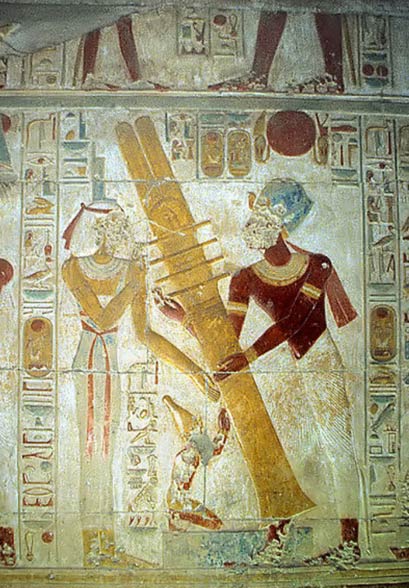
I had this picture in a different post but i put it here because of the 23 degrees angle of the djed. Also the two loops on top of the djed could figure Earth's magnetic field and the four disks high voltage. I got this in a blog post that needs to be rewritten since i started with an idea and ended with two others.
Also this one seem to indicate mass migration or threat from mass migration from the uncivilized South, the ecliptic and the link with heat from Sun.
"The gods in heaven are beheld by the inhabitants of hell, as they move with their heads inverted; whilst the god, as they cast their eyes downwards, behold the sufferings of those in hell."
"the different Narakas known as Raurava, Śúkara, Rodha, Tála, ViÅ›asana, Mahájwála, Taptakumbha, LavaÅ„a, Vimohana, Rudhirándha, VaitaranÃ, KrimÃÅ›a, Krimibhojana, Asipatravana, KrishÅ„a, Lálábhaksha, DáruÅ„a, Púyaváha, Pápa, Vahnijwála, AdhoÅ›iras, Sandansa, Kálasútra, Tamas, AvÃchi, Åšwabhojana, Apratishta, and another AvÃchi. These and many other fearful hells are the awful provinces of the kingdom of Yama, terrible with instruments of torture and with fire; into which are hurled all those who are addicted when alive to sinful practices."
I had this picture in a different post but i put it here because of the 23 degrees angle of the djed. Also the two loops on top of the djed could figure Earth's magnetic field and the four disks high voltage. I got this in a blog post that needs to be rewritten since i started with an idea and ended with two others.
Also this one seem to indicate mass migration or threat from mass migration from the uncivilized South, the ecliptic and the link with heat from Sun.