My idea is Magyars came from Nepal where to this day there is a Magar population while changu is of Chinesed descent and settled as one of the last outposts of the silk road, during and after Roman times and they could be more culturally related to Magyars than with the surrounding Romanian population though in more than one thousand years they exchanged much of the genes with Romanians.
They have this very interesting ancient ballad about a yellow snake and a young man that had his hand swallowed by the snake (song posted below has been re-written in Magyar). The video also contains the image of a white stag, which is linked to the legend of Magor and Hunor, legendary forefathers or Hungarians.
You can clearly hear in the song the distinctive notes of Chinese music written in pentatonic scales (pretty much like rock music in the west).
Could it be about a yellow snake, dragon or even the yellow river.
Here you can hear a similar melody
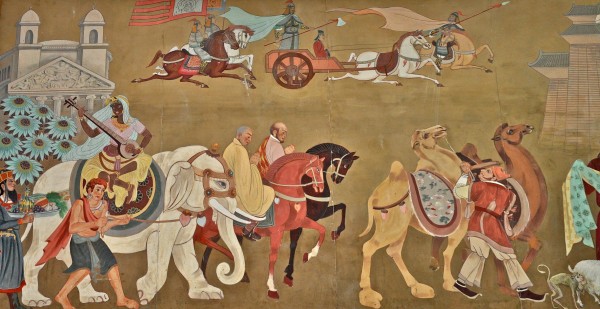
"The Tang captured the vital route through the Gilgit Valley from Tibet in 722, lost it to the Tibetans in 737, and regained it under the command of the Goguryeo-Korean General Gao Xianzhi.
While the Turks were settled in the Ordos region (former territory of the Xiongnu), the Tang government took on the military policy of dominating the central steppe."
https://en.wikipedia.org/wiki/Silk_Road#Tang_dynasty_reopens_the_route
Unlike any other European language, modern day Magyar language has mixed elements of Turkic and Chinese language and is also related to Sumerian (like Turkish is) and also to Japanese. Sumerian. https://drive.google.com/open?id=0B-ShIhkErMIPU2N3WGl5TGh4Y1U

 https://www.google.com/search?q=silk+road&source=lnms&tbm=isch
The presence of Magyars, Changu and Shekelies in Eastern Europe caught in the middle of existing European populations was not a true migration. Instead they where traders and mercenaries, an elite that moved to form outposts on the silk road and were trained in building outposts, resisting and living for extended periods of times without always having contact with their motherland. After silk road was shut down contact ceased at least in the territory of present day Romania, around 900 they could not survive and gathered from all outposts and started raiding adjacent areas until they finally made a deal with Holy Roman Empire, catolicized and settled in roughly the territory of present day Hungary with pockets of minorities in all surrounding countries.
Since they had no agricultural skills all they could do was coral the local population in the space of Carpathian Mountains, roughly present day Transylvania (now part of Romania) by placing the bulk of their numbers at the west or the border with Holy Roman Empire or Panonia or Tisza valley (left on this map) where they where no mountains and smaller numbers in the mountains (slightly different population of Shekelies) and catching the Romanians in the middle which were turned into slave laborarers. Today the situation has changed to the opposite, with 1-2 million Shekelies caught in the middle or Romania and surrounded by Romanians. Rest is... official history.

"The Tang captured the vital route through the Gilgit Valley from Tibet in 722, lost it to the Tibetans in 737, and regained it under the command of the Goguryeo-Korean General Gao Xianzhi.
While the Turks were settled in the Ordos region (former territory of the Xiongnu), the Tang government took on the military policy of dominating the central steppe."
https://en.wikipedia.org/wiki/Silk_Road#Tang_dynasty_reopens_the_route
Unlike any other European language, modern day Magyar language has mixed elements of Turkic and Chinese language and is also related to Sumerian (like Turkish is) and also to Japanese. Sumerian. https://drive.google.com/open?id=0B-ShIhkErMIPU2N3WGl5TGh4Y1U
This map from the times of Marco Polo (1254-1324) is the last one with an outpost close to present day Romania.
Since they had no agricultural skills all they could do was coral the local population in the space of Carpathian Mountains, roughly present day Transylvania (now part of Romania) by placing the bulk of their numbers at the west or the border with Holy Roman Empire or Panonia or Tisza valley (left on this map) where they where no mountains and smaller numbers in the mountains (slightly different population of Shekelies) and catching the Romanians in the middle which were turned into slave laborarers. Today the situation has changed to the opposite, with 1-2 million Shekelies caught in the middle or Romania and surrounded by Romanians. Rest is... official history.


